
Reading is Fun(damental): The Indian Card
- fduggan30

- Aug 16, 2025
- 7 min read
Growing up, I was influenced by reading propaganda.
You may be asking, Faith, what’s reading propaganda? Should you be saying this when literacy rates in America are absolutely abysmal?
The answer? Yes.
Over and over again, parents and teachers would say “reading is fun.” Kindergarten introduced homework as a fun weekend activity, where we clipped out words in magazines, newspapers and menus with words that started with the letter of the week. (Side note: How would this assignment work now? No one gets physical papers anymore. Would this just be clippings from spam mail? F is for fraud, C is for credit card.)
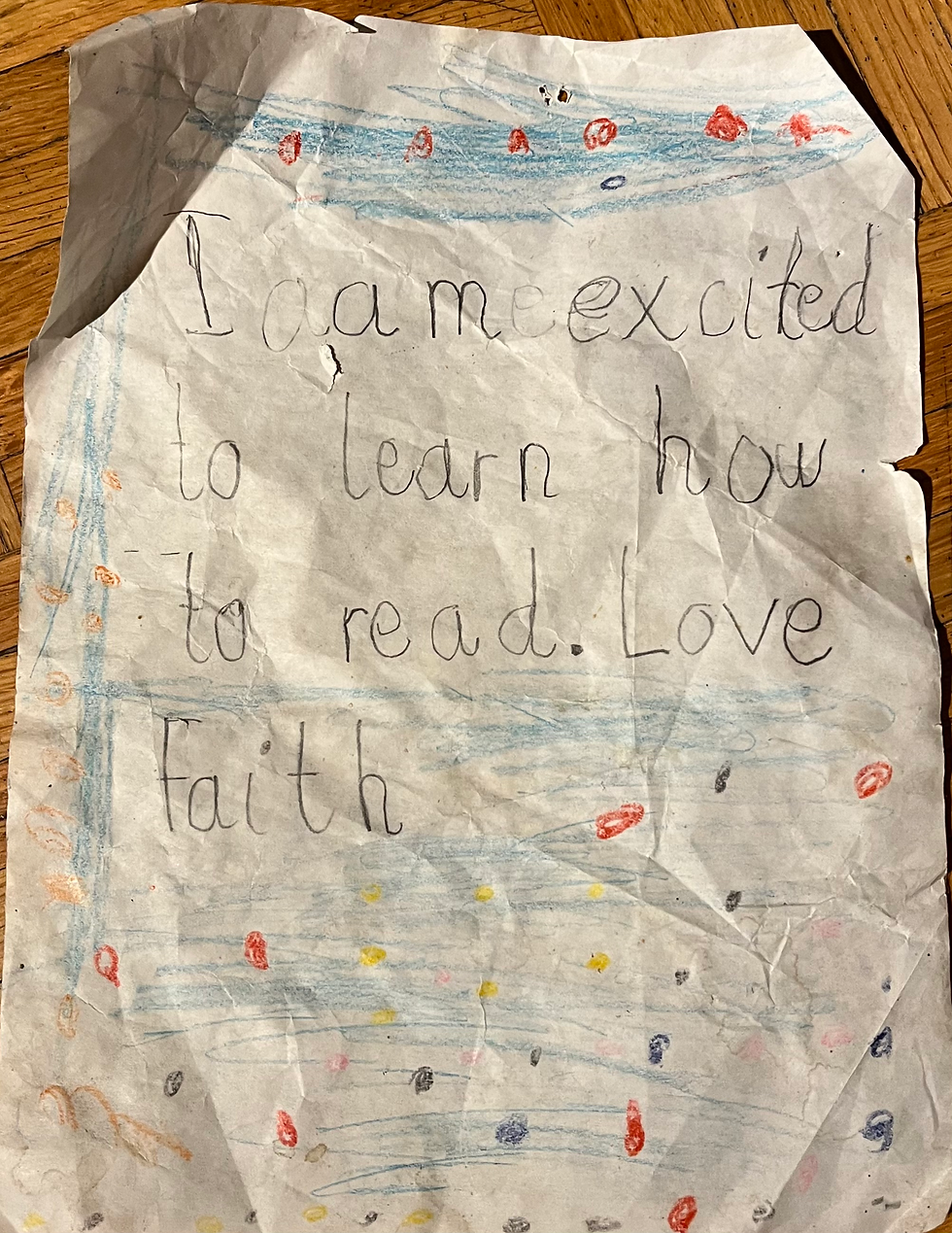
As a through and through teacher’s pet, 5 year old Faith was easily influenced by the reading propaganda and wrote, “I am excited to read. Love, Faith.” But for anyone who knows anything about my childhood, that statement didn’t stay true for long. With two unidentified learning disabilities, I was quickly put into the C reading group. It was (and sometimes still is) a stumbling mess for me to read aloud, and my writing wasn’t much better. In my writing today, I predominantly struggle with knowing the difference between effect (noun), affect (noun), effect (verb), and affect (verb). But back in the day, I confused the classics: their/there and you’re/your, as well as the much more embarrassing, inn/in. At the end of the day, reading and writing were uphill battles.
I spent countless days after school in supplemental schooling, group tutoring, private tutoring, and endless amounts of additional workbooks, all to get me to the point where I could get my ass into a college and survive in a world without these support systems. And while I owe a lot to my friends who edited (and edit) my work and my personal tutoring angel, Maddy, I did it. I got into college. I was even lucky enough to relive my childhood by being forced to take Expository Writing, or if you can read between the lines (something those tutors taught me), the “you’re smart enough to come to this college, but we don’t believe in your reading or writing capabilities, so welcome to English for dummies.”
Even so, I went from trying to write mediocre analytical essays on William Faulkner’s As I Lay Dying, using thoughtful quotations to prove my thesis statement, to sharing my thoughts and opinions about New York and quoting John Mulaney. In this new world of academics, my footnotes were citations, describing people like Mulaney and concepts unfamiliar to my professors, like epidurals (no, this is not a joke). Despite my regret ever giving John Mulaney an ounce of attention, I got A’s and A-’s without batting an eye.

While my blogging days can be pinned to articles in the Spectator, receiving positive feedback from my professor in English for Dummies allowed me to explore and play with my voice. And just like that, one summer in London, bored on my grandmother’s shag green carpet, I made this blog and picked up a book.
I began flipping through the books friends gave me to read on the Tube and came back stateside, tapping through books on an old Kindle, going through my friends' recommendations (The Seven Husbands of Evelyn Hugo, The House on The Cerulean Sea, Iona’s Overdone Rules of Commuting), until I found books of my own.
Post-grad and back in New York with daily 30-minute subway rides, my reading habits continued. As a teacher’s pet with no one to please, I must appease myself, and the romance genre couldn’t satiate my hunger to use a handful of brain cells. At the top of the year, I picked up a historical nonfiction memoir, Negroland by Margo Jefferson, and discovered my inner history nerd. Unable to silence this curious beast, I reread James McBride’s The Color of Water and laughed at my high school annotations, followed by On Juneteenth by Annette Gordon-Reed.
In Gordon-Reed’s book, she explained the convoluted past of Texas and the state’s relationships with Native Americans. Not growing up in Texas, I won’t critique not learning an in-depth summary of the state’s history, even if we should have been taught (literally anything) about Juneteenth; what I found more shameful is the utter lack of education around Indigenous people in US history.
Understanding this hole in my education, my mind began running with the concept of how we define Native Americans today. Why do we linguistically separate Native people throughout North America? While tribes may vary, what is the difference between First Nations, Native Americans, and Indigenous Mexicans? The answer? Colonialization!
For two weeks, I reconceptualized how I have been taught Native American history, because, like Black history, there is no US history without it. Luckily, these concepts ruminated as I pursued the adult book section of Made for You Books at the Kids Passport To Adventure’s Juneteenth Jubilee. Lo and behold, I stumbled upon Carrie Lowry Schuettpelz’s The Indian Card: Who Gets to Be Native In America. The title alone had me hooked.

I continued to think about this book for a month, as it was “too big to bring on vacation.” Finally, the day came when I could crack open this book on the subway on my way to work (my personal favorite time and place to read). Schuettpelz put personal, anecdotal, historical, and statistical information at my fingertips, realizing that mainstream media and white American history created a bias I didn’t know I had.
I never truly thought about the possibility (or fact) that Native Americans could exist without a tribe or that a tribe would deny membership based on blood quantum, patrilineal requirements, or the lack of a direct lineage via the Dawes Rolls (that noted Native Americans between 1898 and 1908). How could I realize this when the concept of Native Americans is spoken of as a monolith (similarly to Black people/culture)?

As the Midwest and Western parts of the US have a higher number of Native people, as claimed on the US 2020 census, I believe or hope or hope that various aspects of Native culture are integrated as part of their larger community and culture. But over here on the Eastern seaboard, I believe that most only interact with Native American culture when scrolling past the inconsequential platitudes of land acknowledgement on school, non-profits, and company websites, which Schuettpelz describes as “just another tap dance routine people perform to make themselves feel better about history.”
While teachers tap dance around the hard truths, students don’t learn about the phases historians use to describe the relationship between the federal government and Native American Tribes: Coexistence (1789-1828), Removal and Reservations (1829-1886), Assimilation (1887-1932), Reorganization (1932-1945), Termination (1946-1960), and Self-Determination (1961-1985). It feels almost impossible to truly grasp these periods when Yellowstone prequels 1883 and 1923, as well as Killers of the Flower Moon, glorify and profit off the brutality that took place.
However, I found one of the most interesting aspects of this book was the relationship between Native Americans and Black folks. Throughout my studies, I have analyzed the Black/White paradigm, which simply puts that white people are the oppressors and Black people are the oppressed; all races and ethnicities outside that binary (Asians, Native Americans, Latinos, and multiracial people) have more privilege than Black people but less privilege than white people. Being born outside this paradigm, I know things aren’t as black and white as they seem (enter laughter here).
I didn’t know that the Five Civilized Tribes: The Cherokee, Chickasaw, Choctaw, Muscogee (Creek), and Seminoles owned slaves. The tribes were given this name by Southern slave owners as they adapted to colonial ways and owned people. This incredibly racist title highlights the Black/White Paradigm, as these tribes were good slave-owning folks like white people, more civilized than those Black folks.
The real kicker here is that some of these Black slaves were biologically related to the Tribes. Similarly to non-Black tribe members, they spoke the Native tongue and participated in Native traditions. However, instead of being Cherokee, they were characterized as Freedmen or Black Native, segregating them from their group. Furthermore, up until recently, descendants of the Cherokee Freedmen were unable to claim Native citizenship (p.134-135).
Rewarding colonial behavior was only one way to separate Black and Native people. They also used opposite qualifications to label groups. On one hand, we have the one-drop rule and the derogatory term passing to describe light-skinned Black people: removing their humanity and keeping people enslaved. But on the other hand, Native Americans could qualify for land (albeit a minuscule fraction of what they were owed), so the US instilled a “system” to qualify and define who could have their Native American card. Native Citizenship and race scholar Mikaëla Adams says it best: “White people weren’t much after Native bodies as land... . So, instead, the goal was to decrease the number of native people to eventually make them disappear” (p. 201).

While it’s somewhat comforting to know that the caste system that binds us to racial structure ensures that no matter how little of my melanin is reactivated in the summer (aka how dark I look), I will always have my metaphorical Black card. Despite my Black card being sometimes rejected by our colorist society, my heart aches for those Native Americans who were raised in or by a community, nation, or tribe but can’t get their physical card because they aren’t Native enough.
Reading this book made me realize I appreciate sitting with the discomfort of these facts and connecting unspoken similarities throughout culture. Similarly to the 3/5ths compromise, white America decided how many Native Americans were registered on the census for years, selecting the answer based on looks and controlling how many people the federal government recognized as Native. Today, in a time where our brewing dictator has reclassified 47 million people’s race, specifically those who are Latino, multiracial, or marked some other race on the census, through a system called Modified Age and Race Census. Meaning, these mofos are coming for my Black card that I have earned through our systemic racial caste system, which this country was literally founded on!
So reading isn’t fun. Reading isn’t always entertaining. Reading is vital to our freedoms to understand and overcome disinformation and oppression. Reading is fundamental to our future as a democratic country, if we can still claim that title. I encourage everyone to read more, not because it is fun, but because knowledge is power, and as writer Clint Smith said, “Once you are armed with history and that evidence, this country can’t lie to you anymore about why it looks the way it does” (p. 124).
Arm yourselves and protect the most vulnerable.



Comments